 Public Interest Energy Solution
1. This Is The Problem Grid Crisis
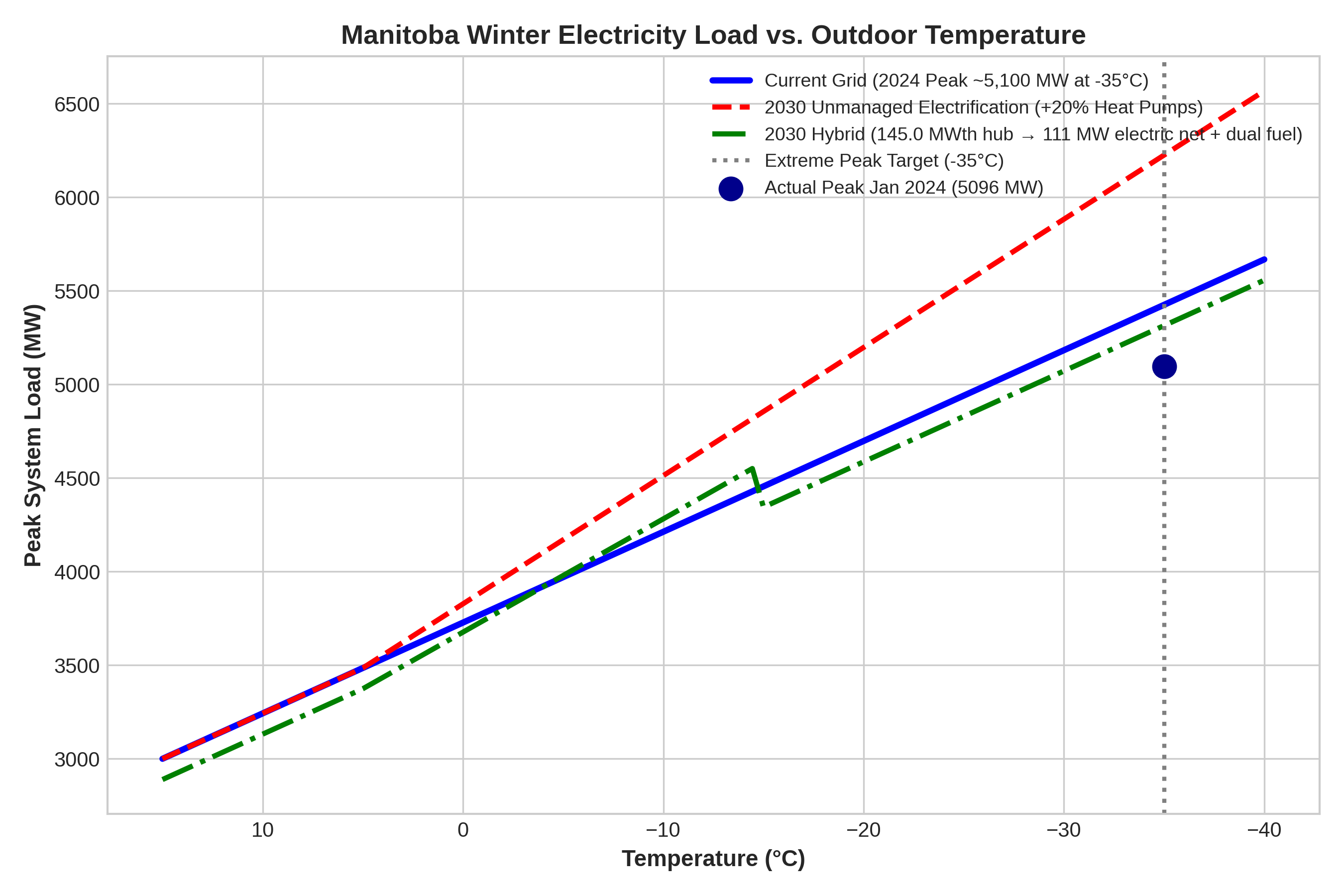
Manitoba’s rapid winter heating electrification is pushing the electrical grid toward a dangerous 600 MW capacity deficit by 2030.
The Severe Cold Snap Penalty (-35°C)
During extreme Manitoba freeze events ($-35^\circ\text{C}$), standard residential heat pumps lose efficiency ($\text{COP} \approx 1.0$) and trigger auxiliary electric resistance coils. This creates an unmanaged heating load spike of 48.5 MW per degree drop below 15°C.
By 2030, projected winter peak demand will reach 5,680 MW against a severe drought firm hydro capacity of only 5,080 MW—creating a critical 600 MW capacity deficit.
2. This Is The Current Proposal Hydro Proposal
Manitoba Hydro proposes spending $3.0 Billion to build 750 MW of new natural gas combustion turbines at the Brandon Generating Station.
Hydro claims that single-use fossil gas turbines are the "only reliable power source" capable of firing up quickly during extreme winter freezing snaps. The proposal calls for installing three 250 MW heavy industrial gas turbines, expanding natural gas pipelines, and building massive cooling towers in Brandon.
3. Costs, Benefits, and Critical Flaws of the Gas Proposal Flaw Analysis
While gas peakers appear simple on paper, Public Utilities Board (PUB) disclosures reveal fatal operational and financial flaws.
Claimed Benefits vs. Real Operational Flaws
- Claimed Benefit: 750 MW of nameplate peak winter generation capacity.
- FATAL FLAW #1 (30% Outage Rate): Public Utilities Board testimony discloses that Brandon gas turbines suffered forced outages during 3 of the 10 highest usage times over the past 5 winters (including Jan 22–23, 2024 at 5,096 MW peak).
- FATAL FLAW #2 (Derated Real Capacity): Because extreme cold causes fuel valve moisture freezing and compressor air density deratings, real delivered firm capacity is only 525 MW.
- FATAL FLAW #3 (Astronomical $/kW Cost): $3.0B divided by 525 MW net delivered power equals $5,714 per delivered firm kW.
Quoted CapEx vs. Real 20-Year Ratepayer Cost
- Quoted CapEx: $3.00 Billion upfront construction cost.
- Hidden Debt Interest (4.5% Bonds): $1.62 Billion in 20-year utility bond interest.
- Natural Gas Fuel Purchases: $1.20 Billion over 20 years of peak dispatch.
- Federal Carbon Tax Liabilities ($170/t): $350 Million in carbon tax penalties.
- REAL TOTAL 20-YEAR COST BAND: $4.5–6.9 Billion
- Ratepayer Bill Drag: Forces a projected 4.5% annual electricity rate hike over the next decade.
4. Here Is Our Plan: Spirited Energy 2.0 NEWPCC Clean Hybrid The Solution
We replace single-use fossil gas peakers with a $1.95 Billion clean hybrid portfolio delivering 413–861 MW of firm electric capability by accreditation scenario (reference 761 MW covers the 600 MW shortfall). Thermal heat (145 MWth) stays on a separate ledger.
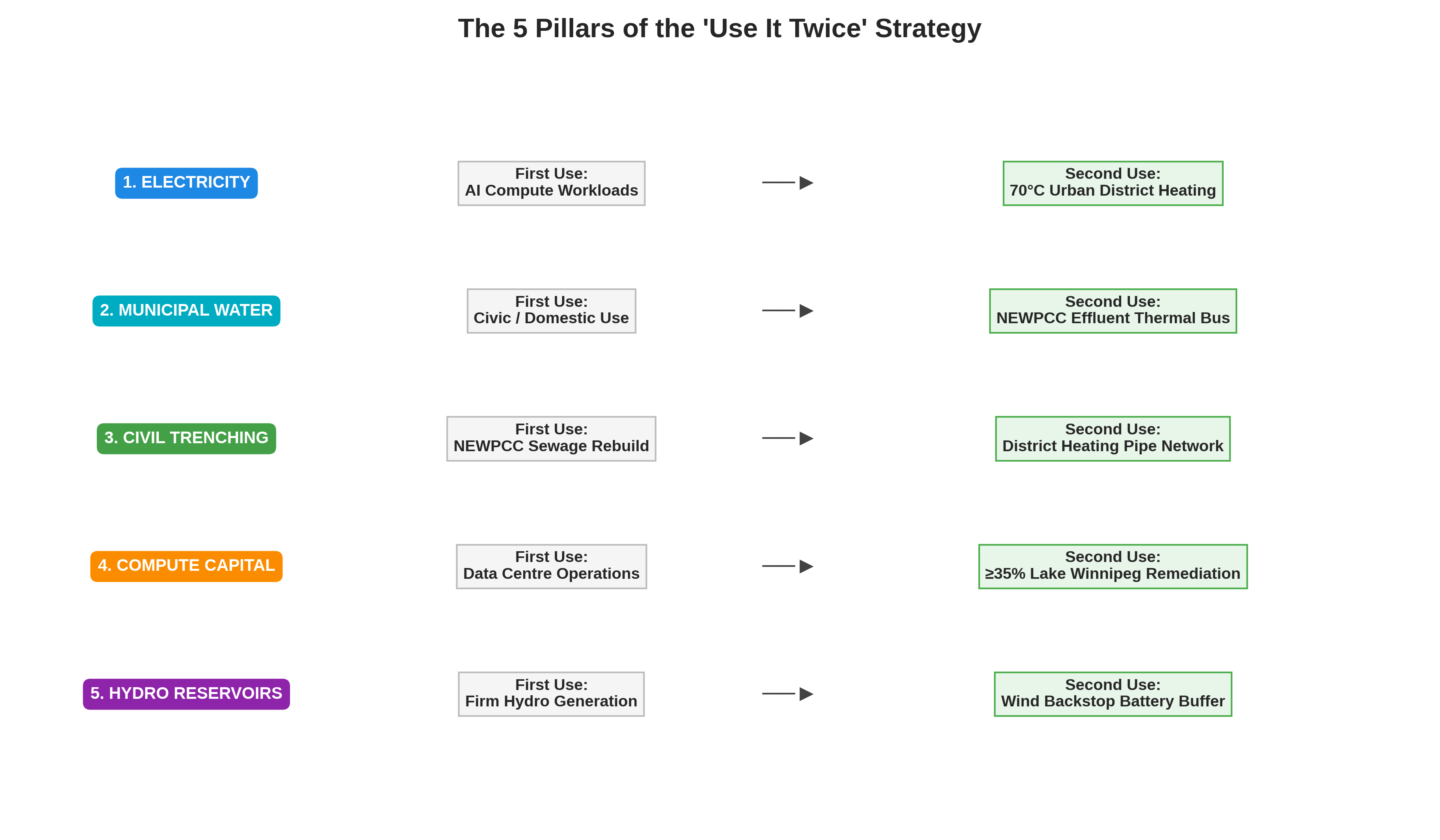
Four Pillars — Electric Ledger (full accreditation 861 MW):
- 1. Battery Storage (BESS 300 MW / 1,200 MWh 4-hr LFP): Modular battery containers to shave 4-hour morning & evening peak spikes ($600M).
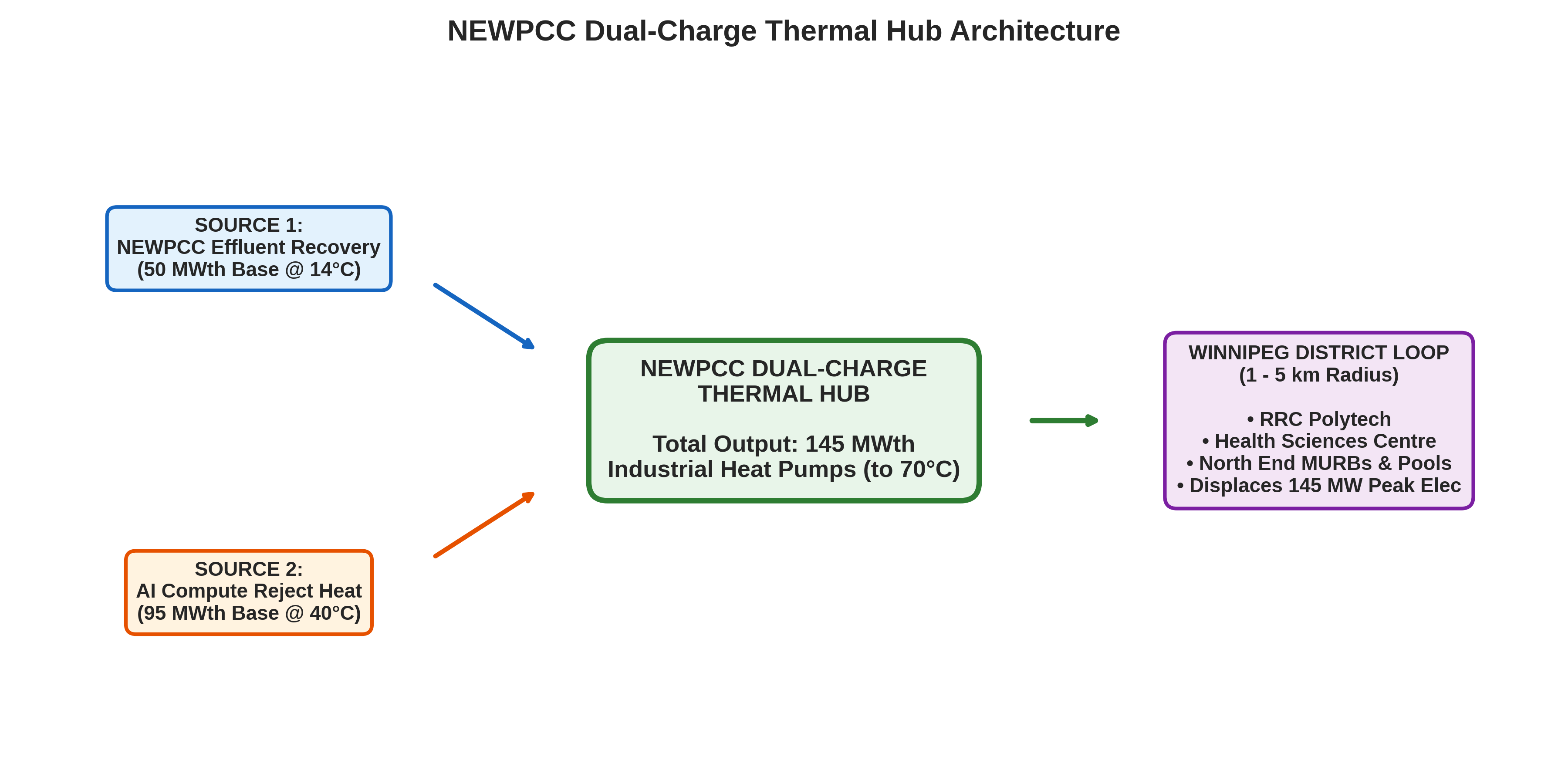
- 2. NEWPCC Dual-Charge Thermal Hub (145 MWth thermal / ≤111 MW electric net): Combines 50 MWth effluent + 95 MWth compute reject; COP 3.2 compressors (~34 MW) yield ≤111 MW net electric peak displacement — never summed as 145 electric MW ($450M).
- 3. Targeted Demand Response (DSM 150 MW): Automated smart thermostat incentives & industrial load shedding ($400M).
- 4. Transmission Intertie & SCADA Upgrades (up to 300 MW): MISO / SaskPower import capacity pending deliverability study; reference case uses 200 MW accredited ($500M).
Revolutionary Civil Piping: Trenchless Ditch Witch & HDD Vibratory Pulling
Instead of slow, expensive open-street excavation, secondary district heating distribution utilizes Horizontal Directional Drilling (HDD) and Ditch Witch Vibratory Pipe Pullers:
- Zero Surface Disruption: Pulls continuous pre-insulated HDPE twin-pipes underground beneath lawns, boulevards, parking lots, and railway lines without tearing up Winnipeg roads.
- 10x Installation Speed: Moves at 300 to 500 metres per day per crew (vs. 15–30 m/day for open trenches).
- Slashes Piping CapEx (60% Savings): Slashes installed piping civil costs from $1,500/m down to $350–$650 per linear metre—ideal for Winnipeg's stone-free Lake Agassiz clay!
5. Compare and Contrast Side-by-Side
Forensic accounting comparison of Manitoba Hydro's Proposed Gas Plan vs the NEWPCC Clean Hybrid Plan.
| Metric / Dimension | Proposed Brandon Gas Expansion | NEWPCC Clean Hybrid Plan | Net Advantage |
|---|---|---|---|
| Upfront CapEx (Gross) | $3,000 Million ($3.00B) | $1,950 Million ($1.95B) | $1.05 Billion Direct Savings |
| Federal ITCs (30% Refund) | $0 (0% for fossil gas) | -$450 Million (30% Clean Tech ITC) | $450 Million Federal Grant |
| Net CapEx Paid by Manitoba | $3,000 Million ($3.00B) | $1,500 Million ($1.50B) | 50% Net Upfront Discount |
| Delivered Firm Capacity (electric) | 525 MW (derate scenario [A]) | 413 / 761 / 861 MW by accreditation | Reference covers shortfall (+161 MW) |
| Delivered Net $/kW Cost | $5,714 / kW (derate scenario) | $1,971 / kW (reference net) | ~65% cheaper at reference |
| Piping Civil Method | Traditional open trench street cut | Ditch Witch Vibratory / HDD Boring | 60% Cheaper Piping ($450/m) |
| Margin vs 600 MW Shortfall | −75 MW (derate scenario) | +161 MW (reference) / +261 MW (full) | Covers at reference+ |
| 20-Year Natural Gas Fuel | $1,200 Million | $0 (Zero fossil fuel) | $1.20 Billion Fuel Savings |
| 20-Year Carbon Tax Liabilities | $350 Million ($170/t trajectory) | $0 (100% Zero-Carbon) | $350 Million Tax Saved |
| REAL TOTAL 20-YEAR ALL-IN COST | $4.5–6.9B band | $1.5–1.8B band | $2.7–5.4B savings band |
6. Pitch to Voters, Government, and Energy Regulators Stakeholder Pitch
Tailored value propositions aligned with the statutory mandates and core interests of all key decision-makers.
Pitch to Voters & Ratepayers
- Protects Household Bills: 20-year savings band $2.7–5.4B vs gas (non-overlapping cost ranges).
- Winter reliability: Reference 761 MW electric covers the 600 MW shortfall (+161 MW); full accreditation 861 MW (+261 MW).
- Restores Lake Winnipeg: ≥35% compute surplus to remediation; mid-case stack ~1,260 t P/yr against a ~3,050 t gap.
Pitch to Cabinet & Government
- Saves $1.05B CapEx / $2.7–5.4B lifecycle band: Protects provincial fiscal standing and Treasury Board borrowing limits.
- 100% CER Compliance: Fully complies with federal Clean Electricity Regulations, unlocking $450M in federal grants.
- Indigenous Partnerships: Unlocks 1,000+ MW of Indigenous-led wind energy co-ownership.
Pitch to Energy Regulators (PUB)
- Least-Cost Public Interest: Net firm cost $1,971/kW (reference) vs $5,714/kW gas derate; electric/thermal ledgers kept separate.
- NERC Reliability Compliance: Direct SCADA sub-second override over 300 MW BESS and NEWPCC heat pumps.
- Long-Term Firmness: Backed by a 25-year Tier-1 Utility Thermal Service Agreement.
7. Next Steps & Master Execution Roadmap (2026–2030) Roadmap
A 48-month phased execution schedule reaching Commercial Operation Date (COD) ahead of the 2030 winter peak.
Regulatory & Policy Directives
File PUB intervener evidence; Minister Sala issues Section 10 Hydro Act directive for NEWPCC hybrid review.
Civil Window & CIB Financing
Install thermal headers in open NEWPCC trench; deploy Ditch Witch HDD piping rigs; close CIB 2.0% debt financing.
Procurement & Compute Build
Procure 300 MW LFP battery packs & 145 MWth heat pumps; construct AI compute pads adjacent to NEWPCC.
SCADA Integration & Cold Testing
Commission BESS & thermal interconnects; conduct simulated $-35^\circ\text{C}$ SCADA stress testing.
Full Commercial Operations
Reference 761 MW electric covers 600 MW deficit; 35% compute surplus restores Lake Winnipeg.
8. Download Whitepapers, Reports, and Technical Numbers Whitepapers & Data
Access the full suite of published PDF whitepapers, forensic accounting spreadsheets, and civil engineering HDD piping analyses.
Real Total Cost Forensic Accounting Whitepaper
20-year driver-attributed cost bands: gas $4.5–6.9B vs hybrid $1.5–1.8B; savings band $2.7–5.4B.
Download PDF WhitepaperTrenchless Ditch Witch & HDD Piping Analysis
Civil engineering study on directional drilling, vibratory pipe plowing, 300-500m/day speeds, and $450/m piping cost reduction.
Download PDF AnalysisNEWPCC Master Synthesis Plan Whitepaper
Combines Manitoba Hydro peak plan, Bill 51 AI compute regulations, and NEWPCC wastewater civil window into a $1.95B plan.
Download PDF WhitepaperThe 5 Undeniable Key Indicators Scoreboard
Scoreboard: gas derate scenario, $5,714 vs $1,971/kW reference, $2.7–5.4B savings band, 145 MWth / ≤111 MW electric hub, Lake Wpg P diversion.
Download PDF ScoreboardSteelmanned Master Synthesis Whitepaper
Stress-test certification: 14-day polar vortex stack, heat pump COP 3.2 lift, open trench civil discount, and counterparty escrow.
Download PDF Whitepaper